

Best synthesizer for beginners
What is the best synthesizer for beginners? I’m assuming that this is your first synthesizer purchase.
I’ve been interested in synthesizers since I was about 13, many years ago. Interested is probably an understatement. People who knew me would have said obsession was more accurate. The first synthesizer I bought was a Sequential Circuits Pro 1. I saved up the required money doing jobs before and after school.
I’ve bought many synthesizers over the years and expect I will in the future.
Hopefully, this article will guide you as you buy your first.
If you want to know how a synthesizer works then read the article.
Why would you want a synthesizer?
You can do it all in software on a laptop. Yes, you can but there’s nothing like a real synthesizer with a front panel and control knobs. Turn it on and it makes sounds, no Windows, no latency and no staring into a screen.
I’m not writing off software synths by the way they are brilliant and I couldn’t be without them, but I also couldn’t be without a proper hardware synth either. Check out my article about the pros and cons of software and hardware synthesisers.

The picture above shows the excellent softsynth, the U-he Repro 1.
Things to consider for the Best synthesizer for beginners
Monophonic or polyphonic
You need to consider if you want a monophonic synthesizer or a polyphonic one.
A monophonic synthesizer can only play one note at a time. Like a woodwind or brass instrument or the human voice. A polyphonic instrument can play chords of multiple notes at the same time like a piano, organ or guitar.
A monophonic synthesizer is very useful for lead lines and bass lines.
Vince Clarke of Depeche Mode and Yazoo used mono synths in rhythmic layers overlapping with different sounds forming chords. You could build up chords by recording multiple tracks. These days with recording being so easy and at such good quality on a PC you can do a lot with a mono synth.
A polyphonic synthesizer can play chords. can sound tremendously powerful and create huge sounds. Years ago polyphonic synthesizers used to be a lot more expensive when compared to their monophonic cousins. These days there’s not much of a gap, if any, between the two.
Analogue or digital
When synthesizers first appeared they were analogue and that became the “sound” of synthesizers. Then digital synthesizers emerged.
The first mainstream digital synthesizer was probably the Yamaha DX7. This was polyphonic and had memories. By memories, I mean that you could store a programmed sound.
Below is a picture of the Arturia VST DX7. It looks a bit different to the original Yamaha DX7 but sounds very authentic.
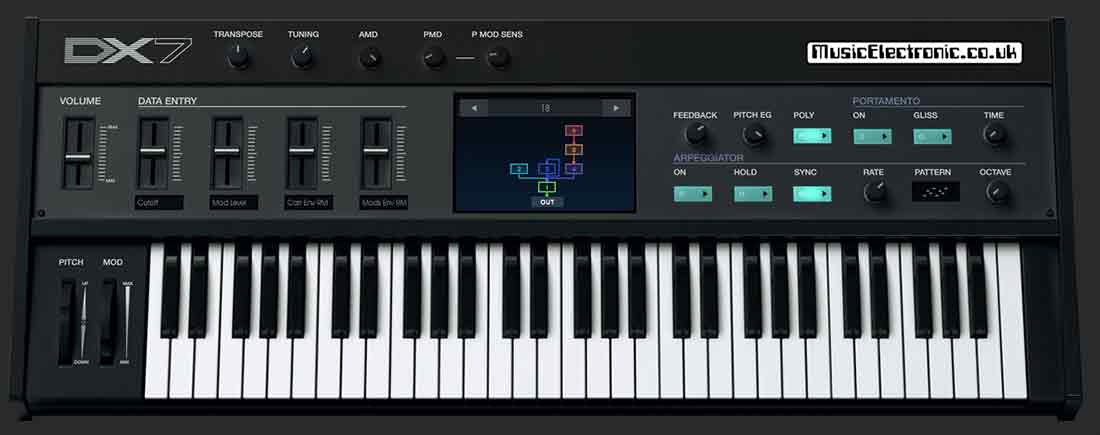
You couldn’t do this with the first analogue synthesizers. You had to draw the settings on sheets of paper with the synthesizer front panel printed on it. These were known as patch sheets and as you can imagine it was a lot more long-winded than pressing a button to store your sound.
As a product of the memory, banks of presets started to appear for the Yamaha DX7. Everyone has heard of at least some of them maybe without even knowing. But some of the pianos, brass, bass and tubular bells became common on many recordings.
In the early days of digital, it had a very hard and precise sound and some people preferred the warmer sound of analogue.
This started the pointless debate on which was better, digital or analogue. It was pointless because they both had their own sound and strengths. Eventually, people used both and still do now. The differences between the two sonically aren’t as polarised as they used to be and you can produce digital sounds on a synthesizer that sound like old analogue ones and vice versa.
I don’t think the analogue or digital question is as important as it used to be. If you like the sounds your synthesisers make, then that’s what it’s about. Not what happens under the hood.
Synthesizer or workstation
Do you really need a workstation instead of a synthesizer?
If you want to sit down and start writing songs a workstation might be more suitable. A self-contained workstation can be a fantastic tool for songwriting. The ability to just turn it on and not have to set up a computer and software shouldn’t be underestimated. This is especially useful as it returns to where you last had it before you turned it off.

A good workstation will enable you to record multiple parts with drums and effects all in one handy unit. Ideal for when inspiration strikes you.
If that’s what you want to do look at a workstation. For more information on synthesizer workstations read here.
If workstations appeal to you you should also have a look at arranger keyboards as well as workstations.
If you are more interested in playing around with sounds you may find a dedicated synthesizer suits you more than a synthesizer workstation. I used to spend many hours playing around with sounds and synthesizers. It was quite a guilty pleasure and very enjoyable but I didn’t end up with much to show for my time!
Sometimes it’s fun just to play around and although you might not end up with much music at the end of it, you will have usually learned a lot on your sonic adventures.
Loudspeakers
The first synthesizer I remember that had a built-in amplifier and loudspeaker was the EDP Wasp.
I was pretty surprised as synthesizers in those days didn’t have loudspeakers built into them. You connected the synthesizer output to an amplifier or a mixing desk. If you just want to put the synthesizer on your table to play it a built-in amplifier and loudspeaker are really useful. It saves you from having to bring an amplifier and speakers into the same room.
Batteries
Similarly to having a built-in loudspeaker, having the machine powered by batteries makes it more portable. The first battery “synthesizer” I had was a Roland MC202. Although strictly a micro composer it also had a self-contained synth, pretty much like the Roland SH101.
I rarely used it on batteries as I had a bedroom studio in those days. Today though I have to put things away when not in use so having the ability to power a device from batteries is a definite advantage.
Portability – Best synthesizer for beginners
Do you want your synthesizer to be portable?
Synthesizers are nowhere near as big as they used to be, so it isn’t the problem it once was, but if you don’t have a home studio to keep everything set up in then you will probably be getting your synthesizer out from a cupboard when you want to use it and in that case, you don’t want something too big or heavy.
If you have a studio to keep everything in and set up, the size and weight won’t be that much of an issue. Unless you want to move it around regularly that is.
Synthesizer for live or studio use.
Do you want to use your synthesizer for home or studio use or do you want to use it live on stage?
You will want different things for a live synthesizer.
For me having used synthesizers live on stage I want full-size keys. Memory recall also has to be easy with dedicated keys. Larger control knobs are easier to use on stage where lighting conditions are sometimes not ideal. You also don’t want anything on stage that has ever crashed.
I haven’t encountered any modern synthesizer that crashes, however, I did once own a Cheetah MD8 drum machine that frequently crashed and locked up. Not want you want during a live performance!
What’s the best synthesizer for beginners?
I think the best synthesizer for a beginner is the Arturia Mini Brute 2 if you have four hundred pounds to spend. There’s no doubt that this synthesizer sounds brilliant. For me, this is what it should all be about.
You can have all the features under the sun but if it doesn’t sound great what’s the point? That’s not to say that the Arturia is missing any features.
Why is the Arturia Minibrute 2 the best synthesizer for beginners?
The Arturia Minibrute 2 has taken what the first version had and improved.
Not an easy thing to do. It’s particularly good in my opinion because it’s easy to use without being too complicated to fully understand. You can start to use and learn it straight out of the box. That’s something you need to be able to do as a beginner but you will never outgrow this machine. So if you can stretch to the £400 to get one you can sleep safe in the knowledge that you’ll be able to use it for years.

The reason for this is that apart from the fact that it’s a great-sounding synth it has something that you may not fully appreciate when you first get the machine but you certainly will after you get to realise what you have bought is capable of.
Patching and expanding
The thing I refer to that is the icing on a fantastic cake is the patch panel.
Without wanting to give you a full review as that’s not what this post is for, I’ll tell you that with that patch panel you will eventually learn to do things that you simply can’t with other synthesizers. You will be able to patch things and experiment in ways that only modular synthesizer owners previously could.
All of this is even before you realise the possibilities that this gives you when you start to plug other things into it.
You could plug analogue sequencers into it to modulate almost anything. You could patch in individual Eurorack modules and route the already versatile oscillators through waveshapers and back into the Minibrute 2.
This is all really beyond this article but I’ve included it to show you that this is not only a brilliant beginner’s synthesizer but one that you can grow into a monster.
This is why for me it’s the best synthesizer for beginners by quite a margin.
Korg Volca
If you can’t afford £400, there is the excellent Korg Volca range.
The Korg Volcas are a range of products that cater for just about every need. If there is something you are specifically interested in with synthesizers then there is probably a Korg Volca especially suited to you.
For the modular experimenter, there is the Korg Volca modular. If you want to start dabbling in modular synthesis this is a great choice if you don’t have a lot of space or money.
For the FM enthusiast, there is the Korg Volca FM.
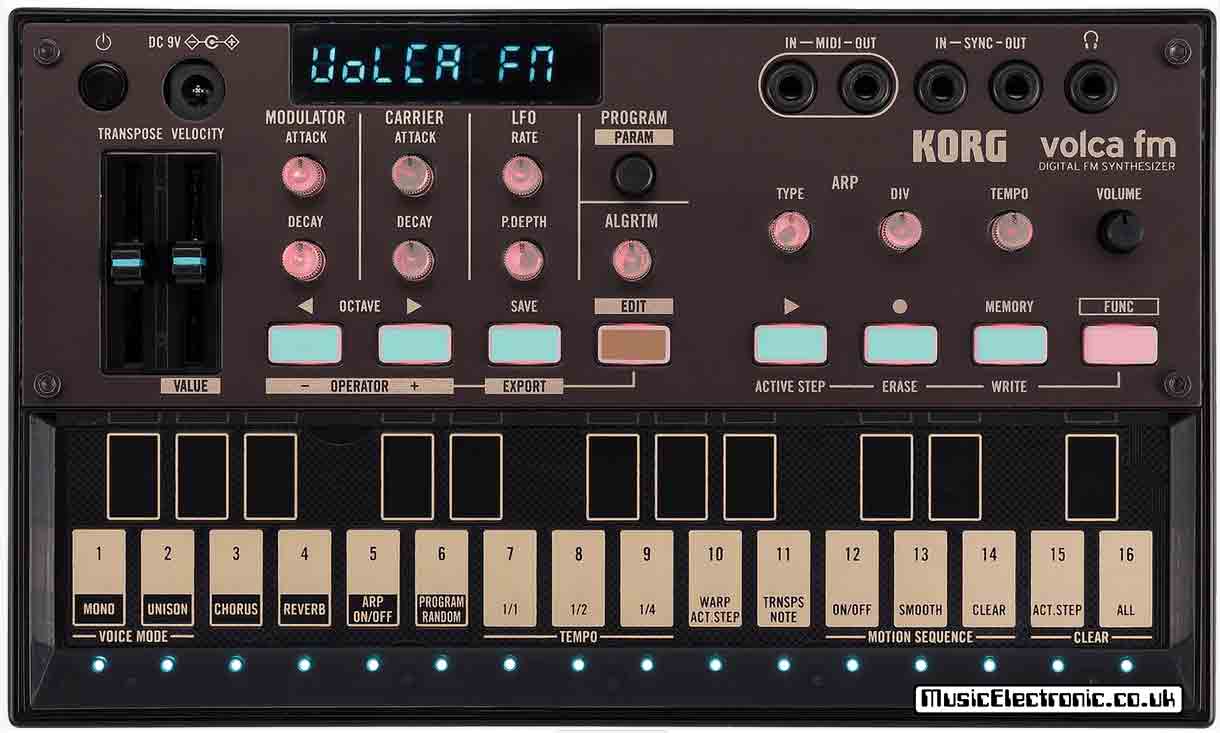
If you are a bass line lover, there is the Korg Volca bass
For the drum machine fan, the Korg Volca Beats. If you are interested in this side of things it’s worth noting that Korg has introduced some more Volcas for drum stuff.
There is the Volca drum, which is a percussion synthesizer and the Volca Kick primarily for bass drum sounds.
Anyway, back to the Korg Volca range as the best synthesizer for beginners.
I have agonised over this decision for ages and I still change my mind between the two models.
unsurprisingly one of the models is the Korg Volca Keys. For the price and what you can do, it’s an amazing machine. I honestly don’t think I’ve heard anyone get this machine and be disappointed. You just can’t be. it sounds great, it’s a little battery-powered maniac of a machine. If you want a mini synthesizer that’s analogue it’s fantastic.
The only reason not to get one is if you have more money and want something better. Like the previously mentioned Arturia Mini Brute 2. Even if you get the Volca Keys and later want something better you’ll still end up using it for loads of stuff anyway.
That word “modular” again
My other, more surprising choice is the Korg Volca Modular. Usually, a modular machine wouldn’t be considered the best synthesizer for beginners because of its complexity.
This is a different machine from the Keys. It’s not as immediate as the Volca Keys but, and here’s the big BUT, it’s far more versatile. It has a steeper learning curve but that’s not necessarily a bad thing as you will learn more with a Korg Volca Modular than you will with a Volca Keys.
For me that puts the Korg Volca Modular in front of the Volca Keys. it is a close call though. I just think that the Modular offers a bit more in the long run.
So that’s my choice, if you’re feeling adventurous and you put in the work, the Volca Modular will give you more mileage but if you want instant gratification, right out of the box then I’d say the Keys may be more suitable for you. I told you it was a tight choice!
There is one thing that I can definitely say and that is both of these machines are extremely good. They are also very versatile and the prices are unbelievable for what you get.
Go and listen to the demos. I’m certain that you won’t be disappointed by either of these machines. If you have the money get both!
They certainly complement each other, as most of the Korg Volca range does.
Korg has been making equipment since I got into synthesizers in the 1980s and you can tell that the Volcas have had a lot of thought and effort put into the design of them.
Best beginners synthesizer for beginners – the conclusion
First I have to say that I have really enjoyed doing this article. I guess that without realising it’s been something that’s been waiting to jump out of me for a while.
There are a lot of decent machines around these days. There really isn’t much released these days that’s rubbish like there was years ago. It just doesn’t get past the design people if it’s not at least pretty good.
What this means for you, the beginner is that it’s almost impossible to buy a poor synthesizer.
There are plenty of synthesizers that I haven’t mentioned. I wanted to do an article on what I think is the best and not just give you a list of decent synthesizers.
There are plenty of posts on the internet that you can read for that.
I’m hoping that you came here to find out what I think is the best synthesizer for beginners. In my opinion that is the Arturia Minibrute 2. If you can’t afford that, I think the Korg Volca Modular is the next one to go for.
About me
I became obsessed with synthesizers in 1979 while I was at school, and have been fascinated by them ever since. I really wouldn’t want to know how much money or time I’ve spent and continue to do.
You may disagree with my opinions but you can’t say I don’t know anything about synthesizers. All the best and happy synthesizing.