

How does a synthesizer work?
A synthesizer is an electronic musical instrument. It works by the electronic circuits generating an initial waveform and then further sound shaping and manipulation of the original changes it further. To answer the question how does a synthesizer work in more detail you have to break down synthesizers into groups.
As the years have gone by different methods of sound production and manipulation have originated and evolved. There are many different types around today.
A synthesizer is a device that produces lots of different sounds. That is inherently what it is for.

Keyboards weren’t part of the first synthesizers. They were just a collection of sound-generating and manipulating devices. Keyboard control was added afterwards. More of an afterthought.
Although they weren’t primarily intended to be keyboard instruments that seems to be how the majority have evolved. There have been plenty of other ways of controlling synthesizers over the years. You may remember when guitar synthesizers were popular along with various types of wind controllers.
There are several methods of synthesizing sounds. These can be broken down into various different techniques. These different techniques explain how the particular types of synthesizers work. Each type of synthesizer has its own way of working.
Analogue synthesizers
This is really the first kind of technology that synthesizers used. Analogue synthesis is also known as subtractive synthesis. This is because you start with a waveform full of harmonics and then use a filter to remove some of them. Hence the term subtractive. It is difficult to say exactly who came up with the idea first as several people were working on similar things at the same time. Dr Robert Moog was definitely one of those people.
If you are interested in this particular subject check out my post about Who invented synthesizers for a more detailed explanation.
Analogue synthesis starts with an oscillator that produces a basic tone or fundamental frequency. Usually, they can at least produce a square wave, a sawtooth wave and a triangle wave. There are others like sine waves but these are the main ones. They all sound different because they have different harmonics. The square and sawtooth, sometimes called a ramp wave have a richer sound as they have more harmonics. The triangle wave is a thinner sound with fewer harmonics.
Once the oscillator has produced a waveform it goes through a filter. The filter is usually swept to give a more dynamic sound and this is what people associate with the sound of the analogue synth.
It is further shaped dynamically in volume to give each note a beginning and an end. Similar to that of a piano or a trumpet. This is where the attack time, decay time, sustain level and release time can be altered. This is also known as the ADSR envelope.
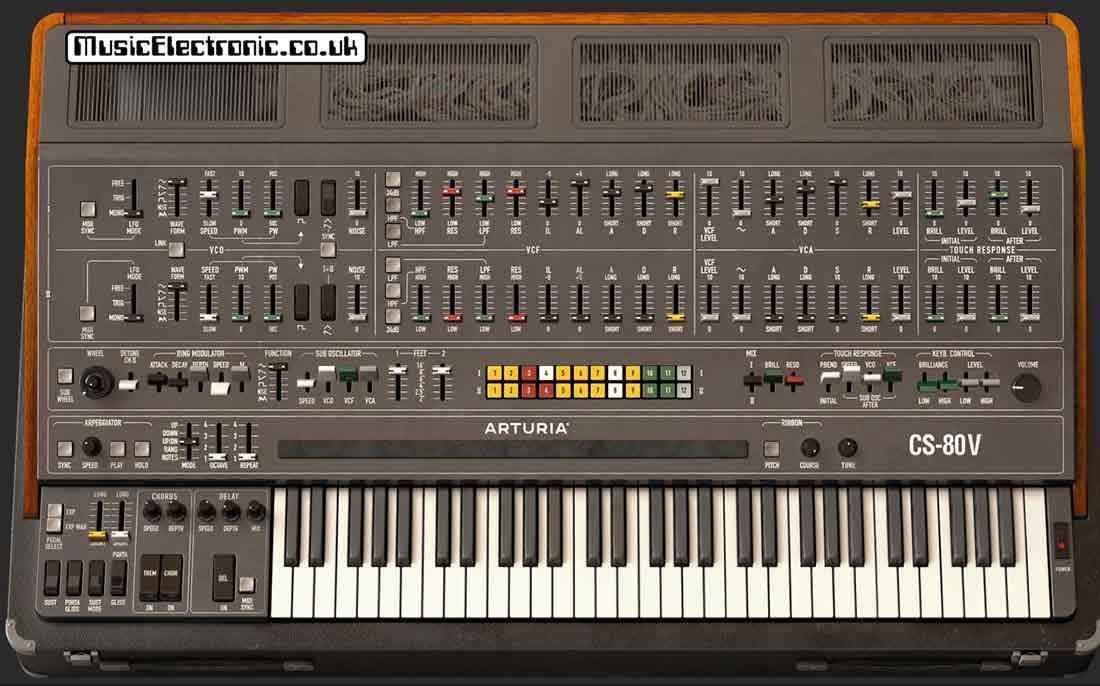
How does a synthesizer work – Modular analogue synthesizers
The first analogue synthesizers were modular meaning that each element such as an oscillator or filter was a physically separate element on a front panel.
All of these individual modules were then patched together with short connecting leads. These were modular synthesizers and could take on the appearance of a cross between a wardrobe and a telephone exchange. Modular synthesizers have been making a bit of a comeback recently.
As electronics have become progressively smaller it’s been possible to make modules smaller and a whole industry of euro rack synthesizer modules has emerged. This has taken modular synthesis to a whole new level with some modules being able to do stuff that wasn’t even imaginable when the first modular synthesizer came out.
If you’re interested in this particularly fascinating area check out my post on Euro rack synthesizer modules.
This is, of course, a much-simplified explanation and if you would like to know more about analogue synthesis and synthesizers then check out my article on how an analogue synthesizer works, which contains more detail.
One of the first synthesizers I owned was the Sequential Circuits Pro 1. This was a particularly good example of a very good analogue synthesizer.

The picture above shows Arturia’s version of the Oberheim SEM. This was Oberhiem’s first analogue synthesiser.
How does a synthesizer work – Digital synthesizers
Just to complicate things more, digital synthesis encompasses a whole umbrella of different techniques.
Frequency modulation or FM synthesis
FM was one of the first forms of digital synthesis. It was made popular in the eighties when Yamaha bought the DX7 to the masses. It used sine-wave oscillators that modulate each other. If you modulate a sine wave oscillator with another one various harmonics are produced depending on the frequency of the oscillator and the amplitude of the modulation. This can be computed mathematically as to what waveforms are produced but it is quite complex mathematics.
Envelopes are used to dynamically control the pitch and amplitude of the operators
The Yamaha DX7 was probably the most popular FM synthesizer ever. This used six operators which were connected together in various combinations that were printed on the panel. These were known as algorithms.
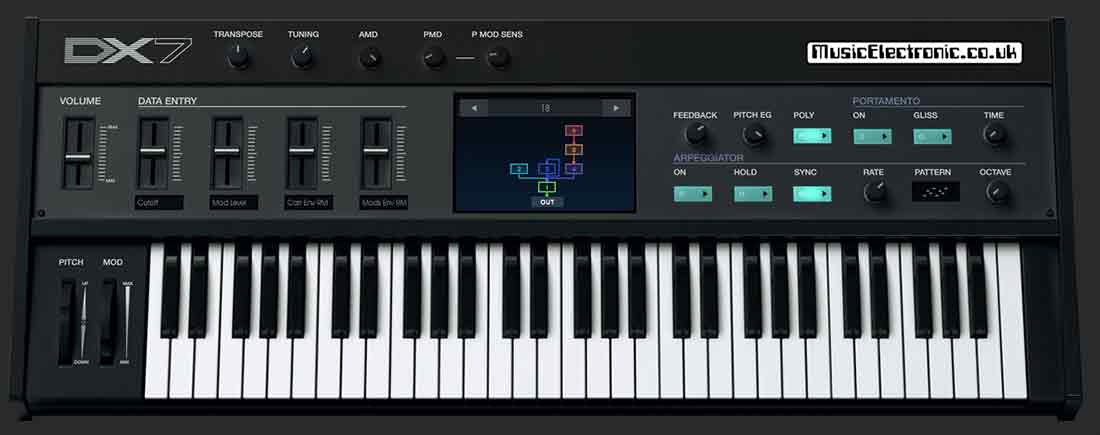
The technology involved in FM synthesis made it easier than analogue to store sounds in memory.
This in itself became a technological turning point because there was now a way for patches to be stored. This led to programmers programming sounds to be used by other musicians using the synthesizer. A whole industry of third-party libraries of sounds grew up.
This was particularly useful as FM synthesizers were notoriously difficult to program.
For more information about FM, synthesizers check out my post here.
Yamaha CX5M II music computer
My first experiments with an FM synthesizer were with a computer strangely enough. It was the Yamaha CX5M II. This was an MSX computer and for those who weren’t around at the time, MSX was a standard brought in to bring some compatibility into the home computer world. It didn’t last long but the CX5 and the CX5 II outlasted the others due to the fact that they had a complete FM synthesizer internally.
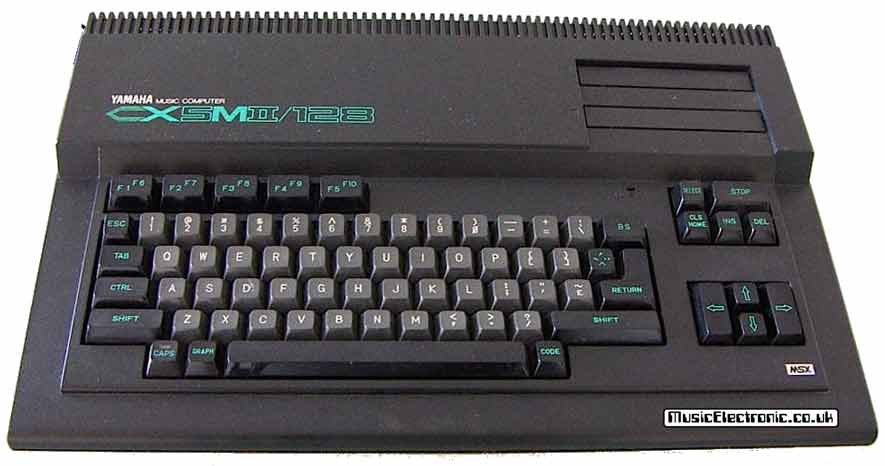
FM synthesizers could produce sounds that analogues couldn’t. There is a sharpness and clarity and an extra level of percussiveness that you can’t get with analogue. The introduction of the Yamaha FM synths shook up the synthesizers industry and pop music in general
How does a synthesizer work – Sample playback synthesizers
After the Yamaha DX synths came Roland’s LA or linear arithmetic synths of which the D50 was the most popular. The D50 used PCM samples and mixed this with traditional analogue synthesis. Roland realised the importance of the initial first portion of a sound and used short samples at the start of each note.
Advanced wave memory
Yamaha came out with AWM which is “advanced wave memory”
If you ever tried sound sampling in the early days, once you had got over the initial this is brilliant, in terms of making music unfortunately in practice things weren’t quite so good. Once you played a note a few semitones away from its sample frequency it started to sound a bit, well, sampley.
The problem was the way the sample was played back. A two-second sound played back at twice the frequency takes one second and is an octave higher.
The formant of the frequency also gets altered and resonant frequencies which should stay the same get transposed.
With a voice, instead of a person singing a note an octave higher, it just sounded like a smaller person or a chipmunk which gave rise to the term chipmunkisation
Early sampling quickly got gimmicky, useful for single effects like orchestral hits, breaking glass and such. It did however become a staple of drum machines where for single sounds and stuff it was ideal.
How does a synthesizer work – sample manipulation
What was needed was a way to manipulate the samples rather than the simplistic play it all back quicker.
As technology, processors and memory became cheaper manufacturers were able to do more with manipulation and the amount of sample time available. The quality went up to 16-bit or even 24-bit which got rid of a lot of the artefacts and aliasing side effects with 8-bit sampling
The Roland D50 manipulated samples and Yamaha did the same with their AWM machines. The DX7 didn’t have audio effect processors on board but around this time the sample playback manipulation synthesiser started to have them in abundance. Not just one effect but you could put multiple effects on one sound. Echo, reverb, a chorus you name it synthesizers had it. Almost anything a studio could do, you could do with a synthesiser. Effects do make synthesizer sounds more impressive.
Yamaha TG500
My first experiences with AWM were with the Yamaha TG500. This was a mammoth of a machine. It was multi-timbral and with loads of polyphony and effects.

The TG500 sounded really good. Always a good start. It had loads and loads of different sounds. Pianos, strings, choir and loads of purely synthetic sounds. These all went through multi-effects processors. As if the originals weren’t good enough in the first place.
With the TG500 you could sound like a complete orchestra or band. It was the perfect match for the Atari ST computer for playing live. Plug the Atari St into the TG500 and whole backing parts could be programmed with just these two devices.
How does a synthesizer work – Phase distortion synthesis
This was something Casio came out with just after Yamaha came out with their FM synthesis. It used a way of distorting the phase of a waveform. No surprise at the name then. At the heart of it was the modulation of the waveform. Without getting too technical it involved synchronising oscillators as was pioneered in analogue synthesis. Then modulating with envelopes as the sound is preprocessed. The envelopes that the CZ could produce could be amazingly sharp and percussive. The waveforms and sounds could be much warmer than traditional digital FM and the sounds could vary enormously from soft and smooth the hard and harsh.
I had one of the original phase distortion synthesizers which was a CZ101. It only had a mini keyboard but it had MIDI in and out so this wasn’t a problem. It also had a limited 4-note polyphony.

The sounds that it could produce were some of my favourite sounds. They seemed very musical and easy to integrate into songs. I know Vince Clarke used a lot of the CZ range when he was sequencing with the BBC Micro at the time of the Circus album. If you listen to the introduction of the title track “The Circus” the first sound that you hear is a Casio CZ preset.
Although I no longer have the Casio CZ101, I still use a VST plug-in on my laptop, the Arturia CZ V. I think it sounds exactly the same but the Arturia takes it further. A sort of new CZ phase distortion synthesizer. I have an article about how a phase distortion synthesizer works if you want more detail.
How does a synthesizer work – Wavetable synthesis
The original wavetable synthesizer was the German-made PPG Waveterm synthesizer. The first time I saw and heard this synthesizer was when Depeche Mode used it on their second album “A Broken Frame”.
The idea here is taken from sound sampling but again manipulates it in a different way.
A sample of a sound can be shrunk down so you effectively just have one cycle of the waveform.
You could have any waveform shape you wanted in memory but it would just be a static waveform and not sonically that interesting. If you had a different waveform in successive memory slots you could step between the different waveforms to provide some sonic movement.
These sequences of individual waveforms became known as wavetables.
Various forms of modulation can be used to step or sweep between the waveforms in these wavetables.
When the PPG Waveterm was first released and used in music, the sounds it produced weren’t really like much else at the time. Because the waveforms were the same cycle length, the pitch remained the same as you swept through the wavetable. You could have a table with quite drastic changes or subtle ones and these steps through the table could be kept in time to produce rhythmic effects as the modulation didn’t have to change the pitch as it usually did with traditional sound sampling. You could also have changes in the waveform that was nothing like the traditional analogue filter so a lot of these types of sounds were unique and quite impressive at the time.
Wavetable for the masses
The machine that brought wave-table synthesis to the masses was the Korg Wavestation. It was used on lots of recordings as soon as it hit the streets. In next to no time its presets were recognisable on plenty of songs in the charts. Everyone has heard the “digital native dance preset” whether they realise it or not. It’s up there with the DX7’s tubular bells.
This wavetable synthesis method is still alive and kicking today and is used in some software synthesis plug-ins. Native Instruments Massive is a particularly good example.
How does a synthesizer work – Physical modelling
Physical modelling was something I remember reading about. One of the first was the Korg Prophecy which had brass and woodwind physical modelling.
It involves computers processing a lot of complex calculations.
Analogue synthesis almost died a death when the digital DX7 hit the street. You found it hard to give them away at one time. After the resurgence of analogue, analogue modelling became another of the physical modelling templates. I still have a hardware synthesizer that uses analogy modelling that the Quasimidi Polymorph.
Physical modelling is really hard to explain without getting into too much technical stuff. But it attempts to model the things that physically make the specific sound. So for instance in brass physical modelling the body of the instrument would be one of the variables. For drum modelling, they would simulate the cylindrical head size the tightness of the skin the intensity of the head strike and the rattle of the snares.
You could then alter these parameters. This makes them a lot easier to alter with some sort of predictability. It’s a lot easier to alter the setting that alters the intensity of the head strike and the tightness of the skin and know how it will sound.
How does a synthesizer work – Re-synthesis
By combining sine waves you can make any sound. This is re-synthesise. It is a form of additive synthesis. Waves are added together to produce complex sounds.
This was and still is one of the most exciting synthesis techniques for me.
I originally thought that this would become one of the biggest areas of sound creation. it hasn’t really happened. There have been a few experiments though.
It goes like this, in its most basic form. By combining sine waves you can make any sound. As the sine waves are just harmonics of the fundamental waveform. You may have seen something like this before. Using Fourier synthesis shows how you can make a sawtooth by adding together sine waves of various frequencies and amplitudes related to the fundamental.
Obviously, a real sound does not just have a single waveform. It would sound very static if it did. The waveforms alter thousands of times a second.
At any particular instance, a complex waveform can be broken down into simple sine waves.
In the same way, it can also be reconstructed.
This is the basis of re-synthesis.
If you just reconstruct the original sound again what’s the point? Isn’t it the same as sampling I hear you ask? Well yes and no. It’s what you can do once it’s reconstructed. You are limited to how it’s played back with an ordinary sample. Most basically you just alter the playback frequency to change the pitch. This leads to a whole host of side effects.
Re-synthesizers
Once you have a sound reconstructed in this manner you could in theory alter any part of the sound you wanted. I’ll admit it doesn’t sound that impressive in words and it wasn’t words that first got me excited by it by an actual demo way back.
Earlier I mentioned the PPG Waveterm synthesizer. This became a whole system not a million miles away from the Fairlight CMI which stood for computer music instrument. The PPG
The Waveterm became the 2.2 and they started to experiment with re-synthesises. The demo I saw sampled a voice saying “mary” and then they re-synthesised it. The replayed sound wasn’t an ordinary sample. It was the PPG resynthesizing the sound. You could still recognise the word as “mary” but didn’t sound like a sample speeding up or slowing down because it wants a sample. It was a synthesizer resynthesizing. Once you’ve got something that can resynthesize you can play around and edit it in ways that you can’t with a sound sampling.
That’s what makes it so exciting for me. You can start with a sample but then it becomes a synthesizer sound that you can do things with that you can’t any other way.
Camel Audio Alchemy
If this particular method of synthesis interests you, check out Alchemy by Camel Audio.
This has an analysis and resynthesis section in which you can import sounds. Up to 600 oscillators are then used to reconstruct it. You can then start doing all the clever stuff like modulating the odd and even harmonic balance and stretching and contracting the harmonic spectrum. It is as impressive as it sounds.
I don’t know any other forms of synthesis where you can do anything else like this.
I’m still trying to get my head around all of this and when I’ve got a bit more experience behind me I’m definitely going to put up a few posts about it.
How does a synthesizer work? Final thoughts
As you can see there are plenty of different methods of synthesizing sounds. Therefore there are plenty of answers to how does a synthesizer work.
There are some similarities though and a few methods work by creating a sound and then modifying it. As time has moved on though, there are more methods springing up that just create sounds from nothing more than microprocessors and software. This is known as virtual studio technology or VST. They live inside of digital audio workstations or DAWs like Ableton Live.

The picture above shows the VST “Pigments”. It is one of the newer plug-in synthesisers and can produce many different types of sounds. You could produce a whole track with this alone!
If you are unfamiliar with these I would definitely check them out. One of my favourites is “Massive” by Native Instruments.
Compared to other synthesizers it really is massive. Even though I’ve been using it for a while I think there are loads more things I’m yet to discover.
Native Instruments Massive and Ableton Live really are worth the money and time investments.
If you are unsure yet about the value of DAWs and VSTs when it comes to synthesizers you get “lite” versions of Ableton Live. There are also plenty of free VST plugin synthesizers to get a feel of how they could benefit you before you splash the cash,
Synthesizers are fantastic electronic musical instruments for music production. Just be careful you don’t get addicted as I did.